Hoe worden sommige jongemannen zo gevaarlijk dat ze aanslagen gaan plegen?
en

the evidence practically screams hysteresis. Even countries that seem to have largely recovered from the crisis, like the United States, are far poorer than precrisis projections suggested they would be at this point. And a new paper by Mr. Summers and Antonio Fatás, in addition to supporting other economists’ conclusion that the crisis seems to have done enormous long-run damage, shows that the downgrading of nations’ long-run prospects is strongly correlated with the amount of austerity they imposed.
What this suggests is that the turn to austerity had truly catastrophic effects, going far beyond the jobs and income lost in the first few years. In fact, the long-run damage suggested by the Fatás-Summers estimates is easily big enough to make austerity a self-defeating policy even in purely fiscal terms: Governments that slashed spending in the face of depression hurt their economies, and hence their future tax receipts, so much that even their debt will end up higher than it would have been without the cuts.Zie speciaal voor Nederland ook mijn eerdere bericht Waar het over zou behoren te gaan: de economische schade van het bezuinigingsbeleid, waarin ik Bas Jacobs aanhaalde:
We zijn door de Grote Recessie meer dan 10 procent van het inkomen kwijtgeraakt, structureel. Vele bedrijven zijn failliet gegaan. En de langdurige werkloosheid is sterk opgelopen. Dit grote verlies is mede veroorzaakt door falend macro-economisch beleid. Teveel korte-termijntekortreductie en te weinig herstel van balansen in de private sector. Na vele jaren saneren komt Rutte II in 2016 eindelijk met een lastenverlichting. Het is nog steeds nodig, maar het is zwabberbeleid en het komt 6 jaar te laat.Diezelfde Bas Jacobs heeft nu ook samen met twee CPB-medewerkers het CPB Achtergronddocument Macro-economie bij balansproblemen en in de liquiditeitsval uitgebracht. Daarin wordt uitvoerig en zorgvuldig uit de doeken gedaan waarom het zo'n slecht idee was van de opeenvolgende regeringen-Rutte om in de recessie te gaan bezuinigen. Hier is een samenvatting van de resultaten van de analyse:
wanneer balansproblemen ernstig zijn of de economie in de liquiditeitsval is beland, zal de economie zich niet uit zichzelf herstellen. De reden is dat de centrale bank niet meer met normaal monetair beleid de neerwaartse druk op de inflatie kan wegnemen. Zolang de nulondergrens op de nominale rente bindend is, stijgen de reële rentes, waardoor de consumptieve bestedingen en de investeringen afnemen. Door dalende inflatie worden ook balansproblemen groter, waardoor consumptieve bestedingen nog verder achterblijven. De output gap wordt bijgevolg groter en de neerwaartse druk op de prijzen wordt sterker. De economie kan dan op een pad van eindeloze stagnatie terecht komen zonder groei, deflatie en schuld-deflatiedynamiek. Monetair en budgettair beleid kunnen dit proces keren, maar alleen als deze voldoende krachtig worden ingezet en de outputgap geheel wordt gesloten zodat de deflatietendenzen worden omgebogen en inflatie ontstaat. Onvoldoende krachtige beleidsimpulsen, die de outputgap niet sluiten, zorgen voor een tijdelijke conjuncturele opleving waarna de economie weer wegglijdt in een stagnatiescenario. Structurele hervormingen en grotere loon- en prijsflexibiliteit hebben niet noodzakelijk gunstige kortetermijneffecten. Ze versterken namelijke de neerwaartse druk op de prijzen en verhogen op korte-termijn reële rentes en schuld-deflatiedynamiek, waardoor de neerwaartse (schuld-) deflatiespiraal aanhoudt.Is het dan zo dat het bezuinigingsbeleid ook in Nederland self defeating is geweest? In de zin dat de overheidsschuld er door is gestegen in plaats van afgenomen? Ja, dat klopt. De overheidsschuld is sinds 2010, toen de bezuinigingen begonnen, als percentage van het BBP van jaar tot jaar toegenomen, van 59 procent in 2010 tot 68,8 procent in 2014. Zie Rijksjaarverslag 2014 in beeld.
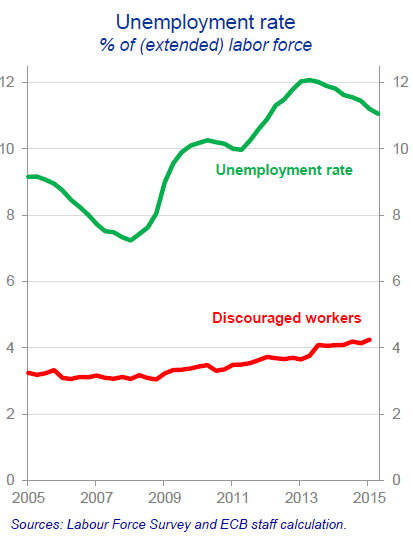
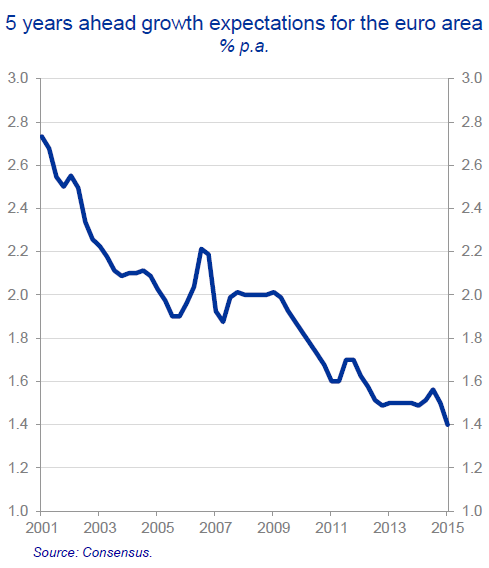 Neem de eerste grafiek, die laat zien hoe de verwachte economische groei door de jaren heen naar beneden werd bijgesteld.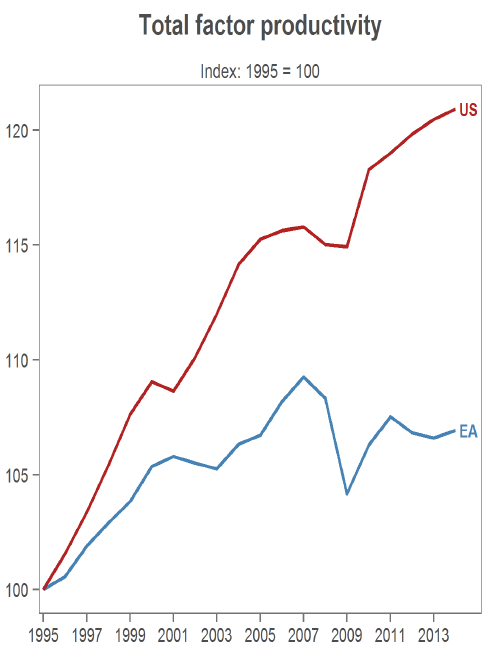
The central idea of the Maastricht Treaty is that the EC countries should move towards an economic and monetary union, with a single currency managed by an independent central bank. But how is the rest of economic policy to be run? As the treaty proposes no new institutions other than a European bank, its sponsors must suppose that nothing more is needed. But this could only be correct if modern economies were self-adjusting systems that didn’t need any management at all.
I am driven to the conclusion that such a view – that economies are self-righting organisms which never under any circumstances need management at all – did indeed determine the way in which the Maastricht Treaty was framed. It is a crude and extreme version of the view which for some time now has constituted Europe’s conventional wisdom (though not that of the US or Japan) that governments are unable, and therefore should not try, to achieve any of the traditional goals of economic policy, such as growth and full employment. All that can legitimately be done, according to this view, is to control the money supply and balance the budget. It took a group largely composed of bankers (the Delors Committee) to reach the conclusion that an independent central bank was the only supra-national institution necessary to run an integrated, supra-national Europe.Het was de neoliberale fantasiewereld waaruit de euro is ontsproten. En die heeft ons een sekte van gelovigen opgeleverd, die nu in Europa nog steeds de lakens uitdeelt. Het vermogen van nationale overheden om een macro-economisch beleid te voeren en het hebben van een eigen centrale bank konden gerust worden afgestaan. Want als er maar een centrale bank is die de prijsstabiliteit in de gaten houdt, dan hoeven de overheden er alleen nog maar voor te zorgen dat hun tekort nooit hoger is dan 3 procent en hun schuld niet uitgaat boven de 60 procent van het BBP.
Let me express a different view. I think that the central government of any sovereign state ought to be striving all the time to determine the optimum overall level of public provision, the correct overall burden of taxation, the correct allocation of total expenditures between competing requirements and the just distribution of the tax burden. It must also determine the extent to which any gap between expenditure and taxation is financed by making a draft on the central bank and how much it is financed by borrowing and on what terms. The way in which governments decide all these (and some other) issues, and the quality of leadership which they can deploy, will, in interaction with the decisions of individuals, corporations and foreigners, determine such things as interest rates, the exchange rate, the inflation rate, the growth rate and the unemployment rate. It will also profoundly influence the distribution of income and wealth not only between individuals but between whole regions, assisting, one hopes, those adversely affected by structural change.En lees dat stuk nog even verder om te zien hoe secuur hij beschrijft wat er in tijden van depressie in de eurozone zou gebeuren.

